AI as a repositioning opportunity for the user experience profession
Views expressed here are my own and do not represent my employer.
Introduction
Generative AI is landing on and around design teams right now, and whether its impact is positive or negative depends on the kind of organisation the team sits in. Over my 20-year career in human-centred design, I've worked across organisations at every level of maturity - from those that treated design as visual polish to those that built it into their strategy. AI lands very differently on those two, and that difference is what this piece is about.
The common view is that AI threatens designers by doing their work faster. That view is half right. AI has made producing interfaces quick and cheap. But it is far less useful in the research, strategy and judgement that decide whether a product is worth building in the first place. Where an organisation already confuses the two, AI does not close the gap. It widens it.
Definitions and scope
Norman and Nielsen (1998) define user experience as all aspects of the end-user's interaction with the company, its services and products; UX design is the discipline that shapes it. Designers navigate both AI practice (how AI tools are used in their work) and AI product (the design of AI products and features). These are distinct challenges which require different responses. In this article, I focus predominantly on AI practice.
UX maturity as the variable
My argument is that generative AI can both strengthen and degrade UX, and which occurs depends on an underlying variable: UX maturity - how far an organisation has moved beyond styling and user interface (UI) production into research, strategy and organisational decision-making. The Danish Design Center's updated Design Ladder (Melander, 2025a, 2025b) sets out the climb. At the lower steps, design is applied at the end of development to give a product its finish - UX reduced to UI. At the upper steps, it is integrated from the outset as a strategic input that shapes the business itself.
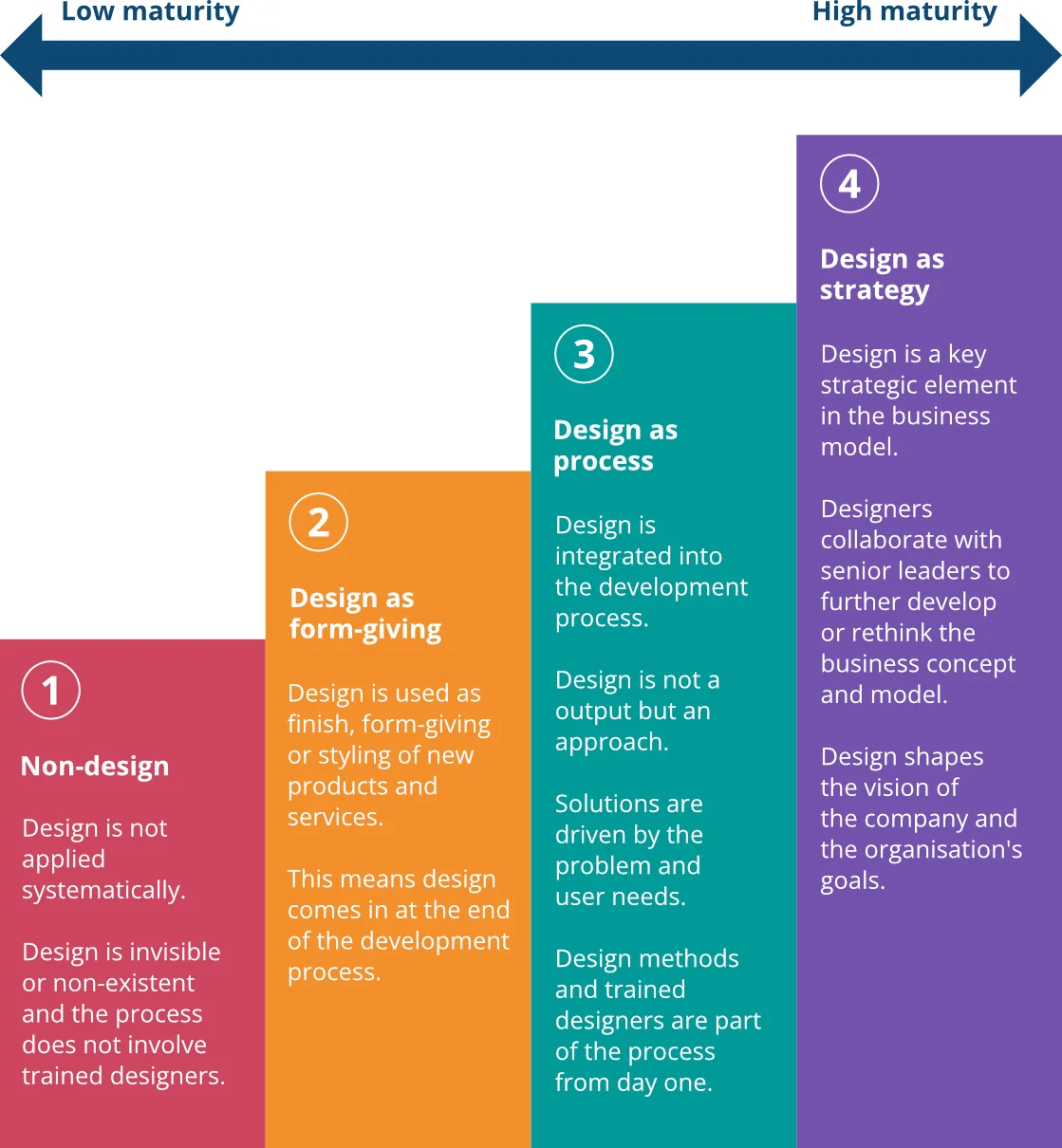
Maturity has commercial consequences. McKinsey scored 300 companies on how well they used design and tracked the results over five years. The top performers grew revenue and shareholder returns roughly twice as fast as their rivals (Sheppard et al., 2018).
The interesting part is where the gap sat. Companies in the middle and bottom were barely distinguishable from each other. Only the top quartile pulled away. Being slightly better than average at deploying design changed little. Being genuinely good changed the numbers.
DORA is a research programme (now part of Google) that has spent over a decade studying how software teams build and ship code. Its 2025 report looked at what happened when those teams started using AI tools. The finding: AI works as an amplifier. It magnified the strengths of strong teams and the dysfunctions of weak ones (DORA, 2025). The tool was not the deciding factor. The system it landed in was.
A reasonable expectation forms by putting these two studies side by side. If design maturity already separates the strong from the weak, and AI amplifies whatever capability it lands in, then AI is likely to widen the design gap, not close it. The organisations that already do design well get sharper. The ones that do not get their weaknesses magnified.
AI as the compounding force
AI is the uneven accelerant that exposes low maturity. As UI generation becomes faster and available to non-designers, organisations that already reduce UX to UI see cause for optimism: a tool doing exactly what they take design to be, only faster. The optimism is misplaced: AI speeds the production of interfaces and leaves untouched the discovery, research and judgement that give design its value. When discovery is skipped, products are built on assumptions: effort is spent on things nobody needs or opportunities are lost to a competitor who did the discovery.
When discovery is skipped, products are built on assumptions: effort is spent on things nobody needs or opportunities are lost to a competitor
Nor is this optimism confined to organisations. The UK government's Creative Industries Sector Plan frames AI predominantly as productivity and opportunity (Department for Culture, Media and Sport (DCMS), 2025); where it acknowledges risk, its concerns centre on copyright and the value of human creativity, not on whether faster production yields products that work for users. The framing is not wrong, but it is incomplete.
Economists have a name for how big technologies actually pay off. Brynjolfsson, Rock and Syverson (2021) call it the productivity J-curve. The idea is that a general purpose technology, one that reshapes how work is done rather than doing a single job, does little on its own. Electricity is the classic example. When factories first electrified, many simply swapped the steam engine for one big electric motor and changed nothing else. The gains were small. The real payoff came later, when firms gave every machine its own motor and laid the factory out around the work rather than around a central power source. That redesign took a generation (David, 1990).
The returns, in other words, come from what an organisation builds around the technology: new processes, new skills, new ways of working. While that rebuild is under way, the gains have not arrived yet. On paper, productivity stalls or even dips. The value is real, but it comes from developing know-how, changing working practices and reorganising teams. As those mature, the payoff shows up and productivity climbs. Plotted over time, the line falls before it rises. Hence the J.
Buy the technology and you have bought very little. The value comes from the reorganisation, and the reorganisation is slow, expensive and easy to skip. In product development the missing investment is discovery capability, and an organisation's UX maturity decides whether the curve ever turns.
I next describe how generative AI is used and misused across UX and adjacent disciplines. I then explain why maturity is so hard to shift and finally I trace two paths, degradation and repositioning, across users, organisations, the UX profession and the national economy.
Degradation is the more likely path
Degradation is the more likely path, but it is not inevitable. The same conditions that make it likely make repositioning possible. The opportunity is real if design leaders and the wider industry choose to act. It rests on one distinction: the value of UX was never primarily UI delivery but the discovery, strategy, empathy and judgement AI cannot replicate - and these matter most when AI is accelerating delivery at pace.
The uneven acceleration: how AI advances some kinds of work faster than others
Generative AI's acceleration is uneven on two dimensions: across disciplines adjacent to UX, and within design itself. UI production - the most visible task AI accelerates - is now within reach of non-designers.
Software engineering pulls ahead
Software engineering is the clearest case of an adjacent discipline pulling ahead. Cui et al. (2026), pooling three randomised trials across 4,867 developers, measured a 26% rise in completed tasks from AI coding tools, with the largest gains among less experienced developers doing routine work.
Inside a design team the effect is visible: as engineering velocity rises, the gap widens between what engineers produce and what designers can support. Where the engineer-to-designer ratio remains unchanged, the bottleneck moves onto design, and designers come under pressure to produce UI faster - leaving less time for the strategic work AI cannot do. The pattern is not unique to one team: a survey of over 900 designers found the same asymmetry, engineering output outpacing design and each designer covering more (Designer Fund and Foundation Capital, 2026).
as engineering velocity rises, the gap widens between what engineers produce and what designers can support
The unevenness comes down to two properties of the task itself: whether the average output is usually right, and whether success carries a clear signal.
Mechanism one: data abundance and average output
A generative model returns the centre of its training data - the average answer. LLMs reach that centre by predicting the most likely next token; image models such as Midjourney by denoising toward the most probable output. These tools accelerate a task where data is abundant and the average is what is needed. Familiar code and UI meet both criteria.
Design's strategic work meets neither. The screens are public; the research, reasoning and trade-offs behind them are not. Nor is the average usually preferable, because it depends on context the average carries no signal of.
An organisation that delegates strategy to a tool returning the average arrives at the same assumptions as every competitor who has done the same.
Mechanism two: the clear success signal for training
After initial training, models are refined by reinforcement learning, tuned toward outputs that score well. How well this works depends on the signal available: some reliable measure of whether an output was actually good, that the training can learn from.
Code offers the cleanest signal: it compiles or it does not, tests pass or fail, and correctness is checked automatically through reinforcement learning from verifiable rewards (RLVR), one technique behind the recent leap in AI coding. UI work offers a weaker one: human preference, fed back through reinforcement learning from human feedback (RLHF), noisy but usable. Strategic UX design offers neither. Whether a design met a real need is recorded nowhere in the artefact; it emerges only later, in use. So the loop stays open not because models are too weak but because that signal - what users need and why - was never there to learn from.
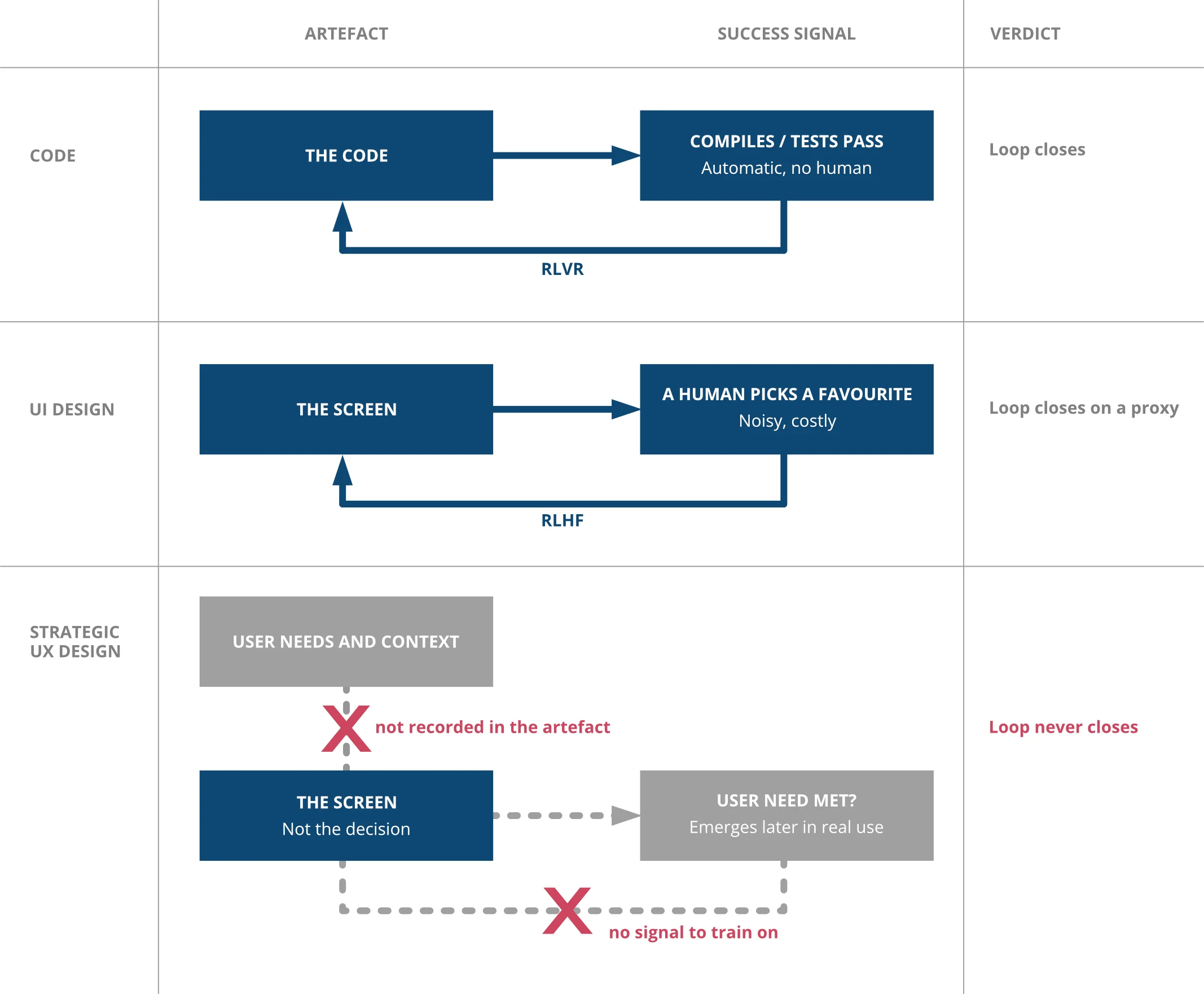
AI accelerates tasks with abundant inputs, a desirable average and a clear success signal. Design's highest-value work has none of them cleanly.
How task properties predict AI acceleration across engineering and design
| Task | Abundant data Whether the task's patterns are well represented in training data. Where the inputs are private, this is the method rather than the material. | Average outcome desirable Whether the most typical answer is usually the right one. | Clear success signal Whether correctness can be checked at training time, automatically or through human preference. | AI acceleration How much faster the task can be completed with current generative AI tools, holding quality constant. |
|---|---|---|---|---|
| Engineering tasks | ||||
| Specification | Partly | No | No | Minimal |
| Architecture | Yes | No | Partly | Moderate |
| Coding | Yes | Yes | Yes | High |
| Testing | Yes | Yes | Yes | High |
| Maintenance | Partly | Partly | Partly | Moderate |
| Documentation | Yes | Yes | Partly | High |
| UX design tasks | ||||
| Formative user research * | No | No | No | Minimal |
| Research synthesis * | Partly | Partly | No | Moderate |
| Problem & goal definition * | No | No | No | Minimal |
| Ideation & concept development | Partly | Partly | No | Moderate |
| Prototype & UI generation | Yes | Yes | Partly | High |
| Evaluative research * | No | No | Partly | Minimal |
* Highest-value UX design tasks
Uneven acceleration within design
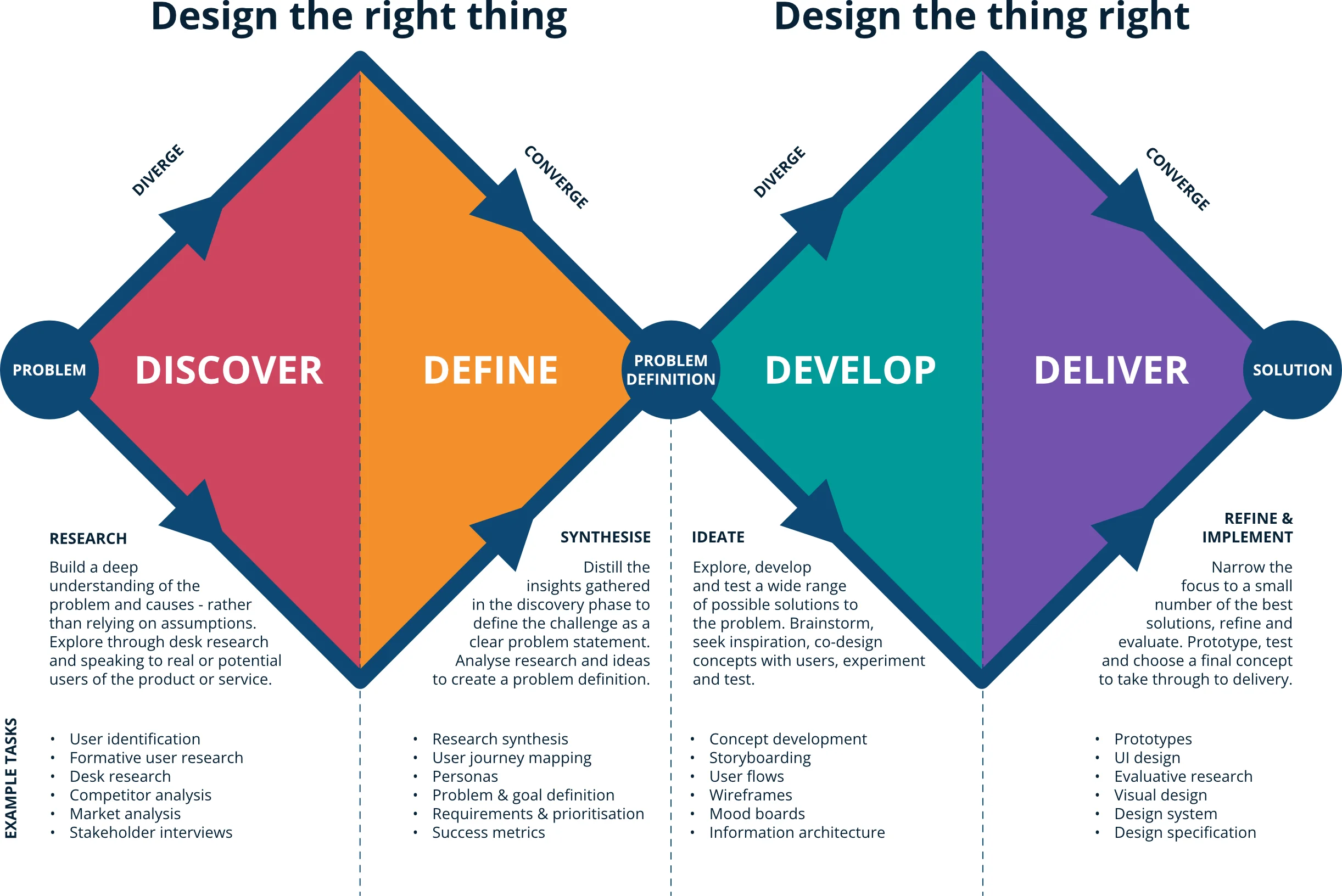
The same split runs inside design. The Double Diamond describes design as two cycles, each one widening then narrowing. The first explores the problem before settling on the right one to solve. The second explores possible solutions before settling on the one to build. Generative AI's help is most visible in prototype and UI generation, and it accelerates production and synthesis across both diamonds. What it does not do, in either, is the judgement: understanding people in their full context rather than as an average, and from that deciding what is worth building - work that fails both tests above.
Where AI genuinely helps
The help is real where the work is production - making an artefact, or generating options from abundant material.
A prototype that once took days now takes minutes: more directions explored, weak ones dropped before anyone commits. But a prototype cannot say what user needs the model quietly dropped, or whether what it kept works. Only evaluative testing can.
The same pattern runs through the other generative parts of design. Ask for moodboards, UI states or first-draft content and a tool returns plenty, fast. The work shifts to choosing. That choice is not taste. It is testing each output against the brief.
AI speeds the making. The judgement stays with the designer.
Where the promise is false
For some tasks, AI looks like it helps but it does not. Earlier the limit was the average the model pulls toward. Here it is what the model has to work from.
AI for research synthesis is worth using, with care. Fed real research, a model clusters and summarises well. But its training objective rewards a plausible answer over a correct one (Kalai et al., 2026, p. 1048), and the risk is greatest where the supplied data is thin and a confident summary can run ahead of the sources. The sources exist to check against, so the risk is manageable.
Caution is needed when using AI as a design critic. Tools produce fluent, plausible critiques. But without knowledge of the specific business goals, context and users, the outputs can be at best generic and at worst inaccurate.
Synthetic users - AI-generated personas offered as a substitute for research with real people - are where I would draw the line. A real persona is built from evidence: research that captures how actual users behave and what they need, outliers included. A synthetic persona is assumed. Assembled from the training data, it returns the typical and never the outlier the research was for, and inherits the data's biases as findings.
Where AI does not help
The previous cases all involved something that could be handed to a model - a brief, a research transcript, a screenshot. For some types of research, understanding comes from being there: a person in the space, watching how people work and asking why. Research and co-design are also powerful tools in winning over a wary team, showing them they were heard before anything changed - trust that AI cannot build.
And research is only an input. The strategic work follows: finding the real problems rather than the assumed ones, weighing them against what the business needs to achieve, and shaping that into strategy - the top of the Design Ladder. That judgement is not in a model.
Democratising UI, not UX
UI production is the one design task AI reliably accelerates, putting it within reach of non-designers. A product manager or engineer can now generate something that looks like a designed prototype. A polished screen used to imply the work behind it: needs understood, assumptions tested, the opportunity validated. That link has come apart. Ambrosino (2026), who leads the Codex app at OpenAI, describes the dynamic: because implementation is cheap, a rough exploration can look ready to ship, and teams over-anchor on it.
because implementation is cheap, a rough exploration can look ready to ship, and teams over-anchor on it
Tools produce finished-looking outputs concealing that nothing has been tested with users. The steering is the design work and recognising what has not been done is part of the judgement.
That knowledge is not universal, even among designers. Asked what craft means to them, more designers named visual polish than clear, usable experience (Figma, 2026, p. 14). When designers define their own craft as the surface, the misconception is not only imposed from outside; it runs through the discipline itself.
What determines acceleration
Task properties - a desirable average output and a clear success signal - decide where acceleration lands. Whether AI helps or harms depends on a second variable: the maturity of an organisation's design practice. As we saw with DORA's amplifier finding, AI magnifies existing strengths and dysfunctions rather than levelling them. Its sharpest finding for user-centred teams is that those with a user focus see AI's benefit amplified, while teams without it see AI harm their performance (DORA, 2025, p. 60).
The two variables compound. AI accelerates the roles around design, and the production tasks within it, faster than the strategic work at its core. Where maturity is low, that acceleration reads as UX gaining ground when only UI has advanced - and each time a plausible screen is taken for finished design, the conflation of UI with UX hardens. This is not individual misjudgement. It is built into how organisations work: why is what the next section takes up.
Why organisations undervalue UX
Section 2 established the misconception at the heart of low maturity: the conflation of UX with UI. If this were only a misunderstanding, advocacy would have corrected it long ago. It persists because two deeper forces hold it in place: incentives and power.
Incentives: the market pays for polish
The market rewards the most visible but lowest value work. Asked which skills are most in demand, designers name visual polish most often and research least (Figma, 2026, p. 9). The same holds inside organisations. Among McKinsey Design Index respondents, only 20% factor design into staff performance reviews, and only 5% tie it to pay (Dalrymple, Pickover and Sheppard, 2021). When design quality counts for nothing in reviews or pay, it counts for little in decisions.
The commercial case is not the problem. As we saw, McKinsey's five-year study linked design maturity to revenue growth and shareholder returns (Sheppard et al., 2018, p. 4). This finding has been public for years without moving anything. Over recent years the number of companies adding senior design roles has doubled, yet around 90% still fail to realise design's potential (Dalrymple, Pickover and Sheppard, 2020). The case is made and the seat granted, and still design is undervalued. Why?
Delivery is visible, immediate and attributable to a person or team. Discovery does two things and gets credit for neither. It prevents failures, which are invisible because they never happened. And it finds the opportunities that competitors without it have missed - but by the time those reach revenue, the credit has travelled to whoever shipped. Revenue urgency, cost pressure and technical debt favour delivery every time. So under-investment is not an error. For the leader judged on a short timeline, it is correct.
AI now raises the return on visible production and leaves the return on discovery exactly where it was. The time for research barely compresses. Generating a screen now takes minutes. The incentives already favoured delivery. AI strengthens them, and the pressure it creates removes the time to ask whether the thing being shipped is worth building.
Power: design sits downstream
In low maturity organisations, direction is set upstream: senior leaders decide what the organisation will build; design receives the decisions and executes them. In the Danish Design Center's 2025 survey of 600 companies, 71% reported design decisions made at the top level, by executive management or owners. The same survey shows why that arrangement matters: executives hold the authority but rank lower on design knowledge, while design departments hold the knowledge but not the authority (Danish Design Center, 2025, p. 18).
By the time design is engaged, the problem has been chosen and the solution usually named. Design is handed the second diamond. The first - the enquiry into whether the right problem was selected - has already been closed.
By the time design is engaged, the problem has been chosen and the solution usually named.
Research still happens, sometimes. At both ends of the maturity ladder I have seen the same patterns: research conducted in volume but rarely reaching the level where strategic decisions are made, and research conducted after those decisions - evaluative work dressed as formative. Feldman and March (1981) explain why this is not a contradiction. Organisations gather far more information than they use, and much of it arrives after the decision, or is never weighed in the decision it was requested for. Gathering information is not a route to a better choice. It is there as a display of competence and legitimacy for those deciding.
AI is now shifting research from decoupled to absent altogether. As engineering accelerates, design is increasingly asked to skip research and feed developers screens.
Why advocacy fails
The strategic half of design never gets to count. That is why advocacy fails. Advocacy argues for more research, earlier, taken more seriously. It assumes the problem is a shortage. But where research is done and ignored, more of it changes nothing. And where AI is squeezing it out entirely, an argument for more of it has even less purchase. Advocacy leaves the mechanism untouched.
A sceptic reads the same structure differently: perhaps the market has priced UX correctly all along - a discipline claiming strategic value it rarely delivered, now reduced by AI to what organisations actually wanted from it. But this assumes user focus is the part organisations can discard. The evidence points the other way: where teams prioritise the user, AI amplifies their performance; where they do not, AI harms it (DORA, 2025, p. 60). Feldman and March (1981) explain why: organisations reward what they can observe. A visible display of rigour signals competence, whether or not it shaped the decision, and where outcomes are hard to measure that signal is what gets valued. The market pays for what it can see - the finished screen - not the thinking behind it.
AI does not remove the forces of incentive and power. Which path UX takes next is decided not by the tools but by choices - the subject of the next section.
The fork in the road: degradation or repositioning
Nothing in the preceding section is a prediction. It describes a structure that permits more than one outcome. One path accelerates what the organisation already rewards - UI faster and the decision made where it always was, on the same assumptions. Output rises and nothing else moves. This is degradation, and it is the default, because it asks nobody to change anything.
The other spends the time AI returns on the discovery the organisation has underfunded, and couples the discovery to the decision. This is repositioning. It is available to everyone and will be taken by few, because it asks those who hold decision-making power to share it when they are not personally incentivised to do so.
Brynjolfsson, Rock and Syverson (2021) find the same split at the scale of an economy. General purpose technologies like AI require large complementary investments, and those investments - in skills, processes and reorganisation - are often intangible and poorly captured in national accounts. So in a technology's early years the gains are understated: the investment is real but uncounted, and productivity appears to lag before it climbs. In product development, I'd argue that investment takes a specific form: the discovery capability that UX maturity provides.
Degradation and repositioning traced at four levels: users, organisations, the UX profession and the national economy
| Degradation | Repositioning | |
|---|---|---|
| Users | Without discovery, products get built on assumptions rather than evidence. Low maturity makes this the default, and AI accelerates it: more gets built, faster, on the same untested assumptions. Users get products that miss their needs - harder to use, less useful, less trusted. |
Where AI accelerates delivery, designers get time back for the work AI cannot do: discovery and time with users. More ideas get tested early, and decisions rest on evidence rather than assumptions. Users get products shaped by genuine need, not guesswork. |
| Organisations | Low maturity ships products on assumptions, and they fail on contact with real use - low adoption, support overhead, wasted investment. The same pattern is visible across the wider AI market. MIT's Project NANDA attributes stalled enterprise generative AI deployments to brittle workflows and misalignment with day-to-day operations rather than model quality (Challapally et al., 2025, pp. 3, 7). What the report frames as a fit-and-integration problem is, in design terms, a failure of discovery. |
Discovery surfaces the false assumptions before they are built in. Where design leaders protect that work as AI accelerates delivery, products ship on evidence, not assumption - so they fit on contact with real use. The result is the inverse of the degrading case: higher adoption, lower support cost, reduced risk, and competitive edge that shows up as revenue. |
| UX profession |
In the degradation path, designers become operators rather than practitioners - steering AI output in roles that are fewer, narrower and more precarious. This works on two fronts. Judgement, interpretation and empathy are practised skills: used less, they atrophy in the designers who have them. And where AI does the entry-level work juniors once learned on, the apprenticeship that forms the next generation erodes. The craft is not passed on. What is at stake here is cultural as much as economic: the identity of a profession, the meaning people draw from creative work, and the value a society places on human design judgement. The profession's own sentiment matches the diagnosis. Segal and Rachitsky (2026) find designers and researchers the most negative of any tech role on nearly every measure, two years running: 63% of designers overwhelmed by the pace of change, and 61% expecting to do more for the same pay, more than any other role. Both groups are the least willing of any role to recommend their profession to someone starting out. The authors name it a retention problem heading toward an exodus. |
Where maturity is built instead, practitioners move up the value chain rather than down it: AI absorbs production, and judgement, research and strategy become the work itself. For those coming through, AI becomes a genuine learning tool, not just a production one - a way to understand new domains quickly, interrogate research in new ways, and build skills there was never time or access to build before. Designers who learn adjacent disciplines - service design, change management, the functions smaller organisations cannot resource - raise their strategic importance and their economic value. Design becomes more creative, more impactful, and worth more. What turns this from possibility into outcome is a question of leadership, which Section 5 takes up. |
| National economy |
These failures are not one organisation's. The incentives and power structures described in Section 3 run across the sector. The under-investment in UX maturity is a national economic pattern rather than an organisational quirk. This is the J-curve at national scale: the complementary investment goes unmade, and the return on widespread AI adoption never arrives. The cost is not only economic. At low maturity, AI-accelerated production becomes the default way of making, and the model's first output ships largely unquestioned - nothing shapes it upstream and nothing tests it downstream. But a model’s defaults carry the biases of its training data. When estimating societies' moral values, LLMs have been shown to overstate the concerns of some Western nations and understate those of others, a skew the authors link to training data over-weighted toward Western, English-language content (Zewail et al., 2026). Discovery is what surfaces the user who falls outside that centre: the culturally specific, the local, the under-represented language. It is exactly what automated production skips. Across the industry, this builds the national digital environment on the model's assumptions about people rather than on research into real ones. One region's expectations - what users value, trust and expect - become the default, baked into the products a whole economy uses. Under-investment and homogenisation are the same maturity failure seen from two sides: one leaves the promised return on AI unrealised, the other designs out the people it was meant to serve. |
Where maturity is built rather than skipped, both failures reverse. The complementary investment gets made, and the J-curve turns: the return on AI adoption arrives, because the capability to use the tools well spreads alongside the tools themselves. Because the tools are available to all but the maturity is not, adoption widens the gap between organisations rather than closing it. The cultural gain follows the same logic. Where designers hold the first-diamond work, AI produces the interface but human judgement decides what is made and for whom. Discovery surfaces the culturally specific, the local and the under-represented language - the needs that never appear in modal training data. Played out across the industry, the national digital environment is built from evidence about who actually uses it, and keeps the variety that reflects the people it serves. |
The tools are the same on both paths. What differs is whether the organisation has the maturity to use them well - which is why the response has to be built, not hoped for.
What closing the gap would require
Building the response means finding the levers that actually move maturity - and most are weak, or sit outside the profession's control. Three matter: design leaders, cost and consequence, and national and structural.
Design leaders
The lever design leaders hold is not the one advocacy reaches for. Section 3 showed that arguing the case to decision-makers does not shift a structure held in place by incentives and power. What leaders control is design's own practice.
Scale discovery to the problem
The elaborate method, the endless workshops, the long horizons - none of that is discovery itself. It is one way of running discovery, and often a bloated one. The point underneath is plain: understand the problem before you start building the solution. That understanding is what cannot be skipped. What flexes is how much work it takes to reach it. Sometimes the problem is new, the users unfamiliar, the market unclear, and it takes real work. Sometimes you already have it - you know these users, you have shipped into this market, the problem is one you have solved before - and then little discovery is needed. That case is real. It is also rarer than teams like to believe, because "we already know" is what a team says just before it builds the wrong thing.
understanding is what cannot be skipped. What flexes is how much work it takes to reach it
So the test is not a feeling. It is evidence. Can you point to what tells you these users need this - research, data, prior work - or are you pattern-matching to a project that only looks similar? Where the evidence is there, keep the discovery light. Where it is not, the confidence is assumption, not knowledge.
This is the judgement the whole argument has been circling. The skill is not running discovery, and not skipping it. It is judging how much each project needs, and being honest enough to separate what you know from what you are only assuming. That is not a call AI can make. A model can generate the screen, cluster the research, draft the plan. It cannot tell you whether you understand the problem well enough to commit. That judgement is what a design leader is for.
Focus, too, has to be decided rather than defaulted into. Left alone, AI pulls design towards delivery, where the acceleration is. The move is to reverse that: decide the focus, then build the enablers - such as a mature design system - that hold quality in the second diamond so attention can go to the first.
Leaders also control whether the capability survives, and it is under pressure from two directions.
Keep critical thinking alive
The first is individual. Judgement and critical distance weaken when designers take the model's output as authority rather than treating it as a thought partner. This is a skill decaying through lack of use, and it is the leader's job to prevent it. Not as a policy we set but as a practice we model: using AI in the open, showing our teams where we draw the line and why, making it a live conversation rather than a value announced once. A team that loses critical judgement slips from designing into overseeing the model's output, one accepted suggestion at a time.
Grow the next generation
The second is generational. As AI absorbs the entry-level work, the next generation loses the tasks that once formed their judgement. This is not a skill decaying; it is a skill that never gets built. Leaders have to keep the pipeline flowing - hire juniors, and protect the work they learn from, even when a model would do it faster, because the point of that work is the person it forms, not the output it ships. But protecting it is not preserving it in amber. We are not training this generation for the world we trained in. We are training them for the one they will practise in, where AI capability keeps advancing. Some of the tasks that formed us were only valuable because someone had to do them by hand. Working out which tasks still build judgement, and which were always just labour, is itself part of the design leader's job now.
Protecting both critical thinking and the pipeline is not sentiment. It is defence of the profession the repositioning depends on.
These levers are real but limited: they work inside design's own practice but do not touch the incentives and power that hold low maturity in place.
Cost and consequence
Maturity does not move on advocacy. It moves on cost - but only when low maturity becomes visibly expensive and that expense is traced back to its cause.
The cost of skipping discovery rarely traces back to the skip: products fail in the market, but nobody connects the failure to a decision made at concept. A cost that is never attributed cannot move anything.
What changes that is AI itself. The same acceleration that drives low-maturity production also makes its failure legible, faster and at scale. NANDA's finding that most enterprise AI pilots return nothing and fail on fit rather than model quality (Challapally et al., 2025, pp. 3, 7), and DORA's penalty for low user focus (DORA, 2025, p. 60), are that cost beginning to surface as a number.
The same acceleration that drives low-maturity production also makes its failure legible, faster and at scale.
None of this moves maturity by itself. The cost does so only if it is read as a discovery failure rather than a model one, and mostly it is. A design leader can produce that reading - tracing a failure back to the concept decision in a post-mortem is within design's own practice. RAND's study of why AI projects fail puts problem definition, not model quality, at the top of the causes (Ryseff, De Bruhl and Newberry, 2024, pp. 5, 14), so the evidence is there to make the case. But producing the reading is not the same as getting the organisation to act on it, and nothing internal at low maturity compels the response. That runs back into those same incentives and power. What might compel the response, from outside, reaches some organisations and misses most.
National and structural
The levers large enough for a structural problem sit above the individual organisation. Two matter most.
A mandate for discovery
The first is public procurement and assurance. The government's own Service Standard makes understanding users and their needs its first requirement, and services are assessed against it (Government Digital Service, 2019). A discovery requirement carried through formal assessment is a different instrument from any argument a designer can make inside a room. It can reach the decision that research never reaches, because approval depends on it - not gathered and set aside, but a gate the decision has to pass.
From position to leverage
The second is the profession's own bodies. Advocacy is not missing at national scale: the Design Council already frames AI's value around identifying real needs before building, and the conditions for adoption rather than production alone. The gap is not the position. It is that a correct position, stated nationally, binds nobody. The body holding the line needs the instruments - procurement standards, professional standards, education - that turn a stated value into a condition someone has to meet.
None of these levers is certain to be applied. The lever design leaders control is limited; those large enough to move the structure sit outside it and are rarely used. The likely result is not a levelling but a widening gap between organisations that use AI well and those that merely adopt it.
Conclusion
The tools are the same on both paths. What decides between them is maturity - whether an organisation holds the discovery, strategy and judgement to use AI well, or merely adopts it. That is the argument I have traced, and it does not stop at the edge of an organisation.
The national ambition rests on the optimistic reading. The Creative Industries Sector Plan targets a rise in annual investment in the sector from £17bn to £31bn by 2035 (DCMS, 2025, p. 5), and frames AI as productivity and opportunity in reaching it - even as it concedes that human creativity becomes "more valuable than ever" (DCMS, 2025, p. 6). The optimism has an evidence base. Analysing over 168 million UK job postings, Wang et al. (2025) find demand for creativity and AI skills increasingly co-occurring after ChatGPT: the tools are pulling creative judgement in, not designing it out. But the same study carries the warning the plan does not. That co-occurrence is skill-biased and spatially concentrated: strongest in high-skilled roles and established creative clusters, while demand outside them stagnates or falls. Adoption is near-universal; benefit is not. This is the maturity gap this article has traced, restated at national scale.
A country can adopt the tools and leave the capability stranded. Capability is far more than access to the technology: it is the maturity to decide what is worth building and for whom. And it is not self-renewing. As AI takes the entry-level work on which each cohort once learned, the mechanism that reproduces skilled judgement decays, and the stranding compounds across generations. The optimistic scenario is real, but it is not the default. It arrives only where the discovery, strategy and judgement that turn a tool into an advantage are held and built. That is the repositioning opportunity for UX: to do the work AI cannot and become more valuable for it.
Capability is far more than access to the technology: it is the maturity to decide what is worth building and for whom.
But the opportunity is larger than survival. A general-purpose technology pays off only once work is rebuilt around it - the J-curve and the reason electrification delivered nothing until factories were redesigned around the motor, four decades on (David, 1990). Installing the tool is not the reorganisation that makes it pay.
That reorganisation has requirements, and they are human ones. Understanding people. Mapping and rebuilding how they work. Building trust. Working inclusively, across the whole organisation. This is the core of what human-centred design is - and it is exactly what a technology like AI needs to pay off.
So the profession AI appears to threaten is the one its success depends on.
Design does not merely survive AI.
AI needs design.
References
- Ambrosino, A. (2026) 'OpenAI Codex lead on the new shape of product work', interviewed by L. Rachitsky, Lenny's Podcast [Podcast], 28 June. Available at: https://www.lennysnewsletter.com/p/openai-codex-lead-on-the-new-shape (Accessed: 11 July 2026).
- Brynjolfsson, E., Rock, D. and Syverson, C. (2021) 'The productivity J-curve: how intangibles complement general purpose technologies', American Economic Journal: Macroeconomics, 13(1), pp. 333-372. doi:10.1257/mac.20180386.
- Challapally, A., Pease, C., Raskar, R. and Chari, P. (2025) The GenAI Divide: State of AI in Business 2025. MIT Project NANDA. Available at: https://mlq.ai/media/quarterly_decks/v0.1_State_of_AI_in_Business_2025_Report.pdf (Accessed: 19 July 2026).
- Cui, K.Z., Demirer, M., Jaffe, S., Musolff, L., Peng, S. and Salz, T. (2026) 'The effects of generative AI on high-skilled work: evidence from three field experiments with software developers', Management Science. doi:10.1287/mnsc.2025.00535.
- Dalrymple, M., Pickover, S. and Sheppard, B. (2020) Are you asking enough from your design leaders? McKinsey & Company. Available at: https://www.mckinsey.com/capabilities/mckinsey-design/our-insights/are-you-asking-enough-from-your-design-leaders (Accessed: 14 July 2026).
- Dalrymple, M., Pickover, S. and Sheppard, B. (2021) Made to measure: getting design leadership metrics right. McKinsey & Company. Available at: https://www.mckinsey.com/capabilities/tech-and-ai/our-insights/made-to-measure-getting-design-leadership-metrics-right (Accessed: 14 July 2026).
- Danish Design Center (2025) Design Delivers 2025: design drives business competitiveness. Available at: https://ddc.dk/wp-content/uploads/2025/06/Design-Delivers-ENG.pdf (Accessed: 5 July 2026).
- David, P.A. (1990) 'The dynamo and the computer: an historical perspective on the modern productivity paradox', American Economic Review, 80(2), pp. 355-361.
- Department for Culture, Media and Sport (DCMS) (2025) Industrial strategy: creative industries sector plan. Available at: https://assets.publishing.service.gov.uk/media/685943ddb328f1ba50f3cf15/industrial_strategy_creative_industries_sector_plan.pdf (Accessed: 5 July 2026).
- Design Council (no date a) The Double Diamond. Available at: https://www.designcouncil.org.uk/resources/the-double-diamond/ (Accessed: 12 July 2026).
- Design Council (no date b) Framework for innovation. Available at: https://www.designcouncil.org.uk/resources/framework-for-innovation/ (Accessed: 12 July 2026).
- Design Council (no date c) AI: designed and deployed for good. Available at: https://www.designcouncil.org.uk/our-work/projects-programmes/archive/ai-designed-and-deployed-for-good/ (Accessed: 20 July 2026).
- Designer Fund and Foundation Capital (2026) AI in Design Report 2026. Available at: https://stateofaidesign.com/chapters/teams (Accessed: 20 July 2026).
- DORA (2025) State of AI-assisted software development 2025. Google Cloud. Available at: https://dora.dev/research/2025/dora-report/ (Accessed: 11 July 2026).
- Feldman, M.S. and March, J.G. (1981) 'Information in organizations as signal and symbol', Administrative Science Quarterly, 26(2), pp. 171-186. doi: 10.2307/2392467.
- Figma (2026) State of the Designer 2026. Available at: https://www.figma.com/reports/state-of-the-designer-2026/ (Accessed: 11 July 2026).
- Government Digital Service (2019) Service Standard. Available at: https://www.gov.uk/service-manual/service-standard (Accessed: 20 July 2026).
- Kalai, A.T., Nachum, O., Vempala, S.S. and Zhang, E. (2026) 'Evaluating large language models for accuracy incentivizes hallucinations', Nature, 653(8116), pp. 1047-1051. doi:10.1038/s41586-026-10549-w.
- Melander, C. (2025a) Vi bestiger stadig Designtrappen [We are still climbing the Design Ladder]. Danish Design Center. Available at: https://ddc.dk/vi-bestiger-stadig-designtrappen/ (Accessed: 5 July 2026).
- Melander, C. (2025b) 'We are still climbing the Design Ladder', LinkedIn, 11 March. Available at: https://www.linkedin.com/pulse/we-still-climbing-design-ladder-christina-melander-rj1if/ (Accessed: 5 July 2026).
- Norman, D. and Nielsen, J. (1998) The definition of user experience (UX). Available at: https://www.nngroup.com/articles/definition-user-experience/ (Accessed: 5 July 2026).
- Ryseff, J., De Bruhl, B.F. and Newberry, S.J. (2024) The root causes of failure for AI projects and how they can succeed: avoiding the anti-patterns of AI. RR-A2680-1. Santa Monica, CA: RAND Corporation. Available at: https://www.rand.org/pubs/research_reports/RRA2680-1.html (Accessed: 21 July 2026).
- Segal, N. and Rachitsky, L. (2026) 'How tech workers are feeling in 2026: a workforce splitting in two', Lenny's Newsletter, 7 July. Available at: https://www.lennysnewsletter.com/p/how-tech-workers-are-feeling-in-2026 (Accessed: 14 July 2026).
- Sheppard, B., Kouyoumjian, G., Sarrazin, H. and Dore, F. (2018) The business value of design. McKinsey & Company. Available at: https://www.mckinsey.com/capabilities/tech-and-ai/our-insights/the-business-value-of-design (Accessed: 14 July 2026).
- Wang, Z., Baksy, A., Bakhshi, H. and Siepel, J. (2025) Demand for creativity and AI skills in the post-ChatGPT labour market: evidence from UK job vacancies. Creative PEC Discussion Paper No. 2025/2. doi:10.5281/zenodo.17589979.
- Zewail, A., Figueroa, A., Graham, J. and Atari, M. (2026) 'Moral stereotyping in large language models', Proceedings of the National Academy of Sciences, 123(10), e2519941123. doi:10.1073/pnas.2519941123.